Pearson Edexcel · GCSE · English Literature
Unseen Contemporary Poetry Comparison (two unseen poems linked by theme)
Master the art of comparing unseen contemporary poetry. This guide equips you with the analytical toolkit and comparative frameworks needed to confidently dissect any poem and secure top marks in your GCSE Literature exam.
- 4 min read
- 2 worked examples
- 4 practice questions
- 8 key terms
Study Notes
Overview
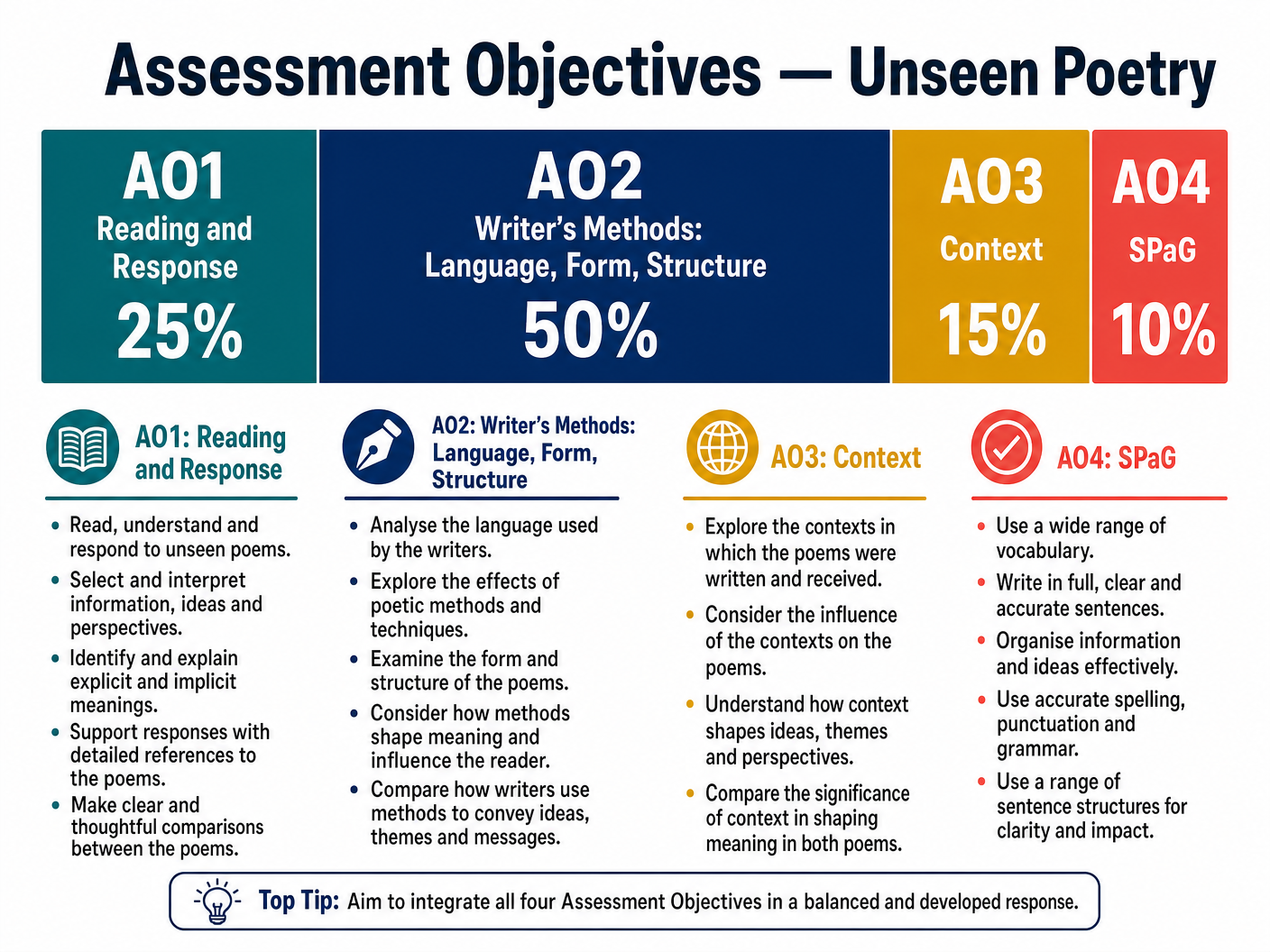
Component 2, Section B, Part 2 of your GCSE English Literature exam presents a unique challenge: the Unseen Contemporary Poetry Comparison. Unlike the anthology, where you have months to dissect every syllable, here you must rely entirely on your analytical toolkit in real-time. Examiners are looking for your ability to read closely, think critically, and compare how two different poets use language, form, and structure to explore a shared theme. This isn't about knowing the 'right' answer; it's about building a convincing, evidence-based argument that demonstrates your understanding of the writer's craft.
The Core Challenge: Comparison
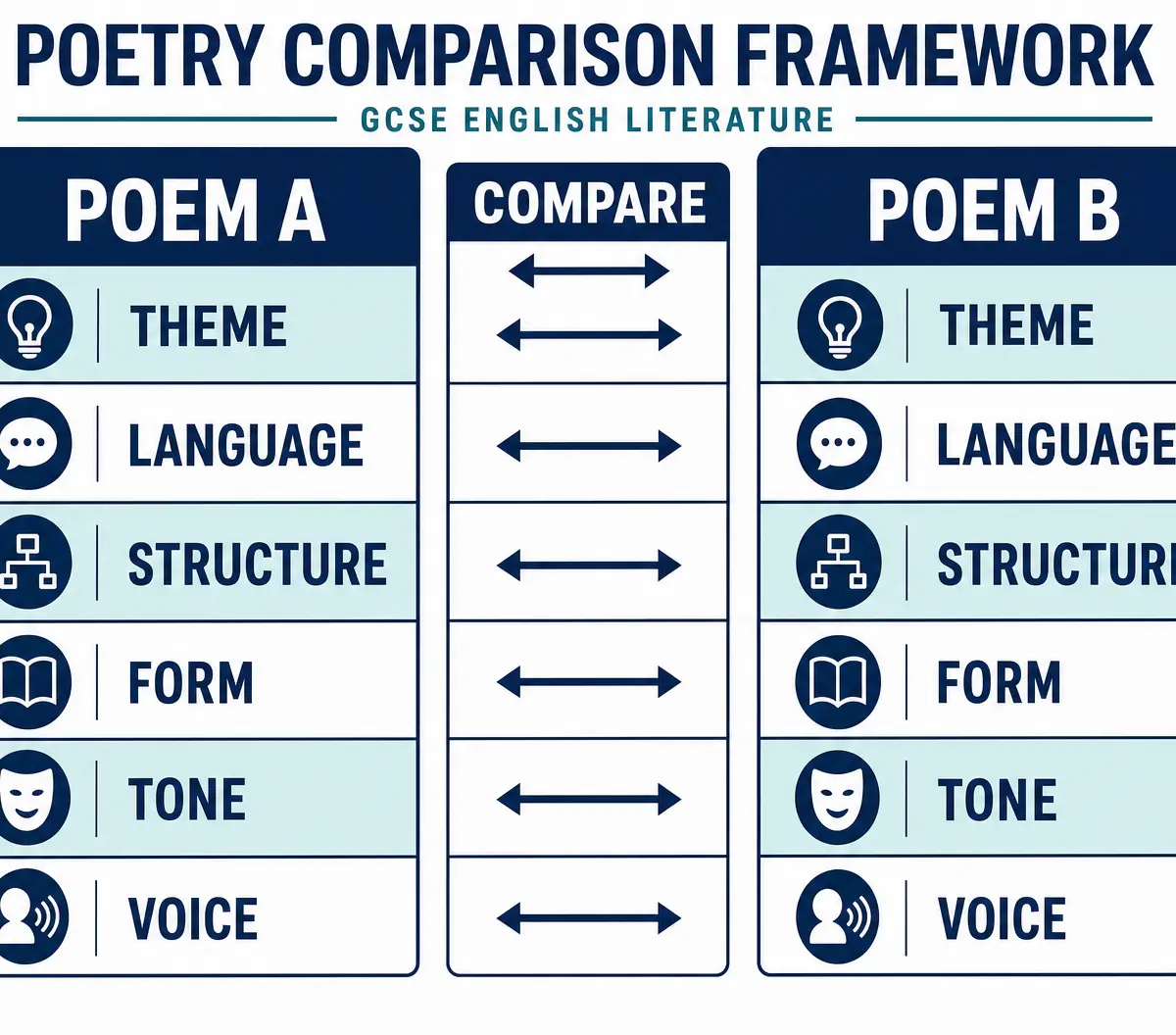
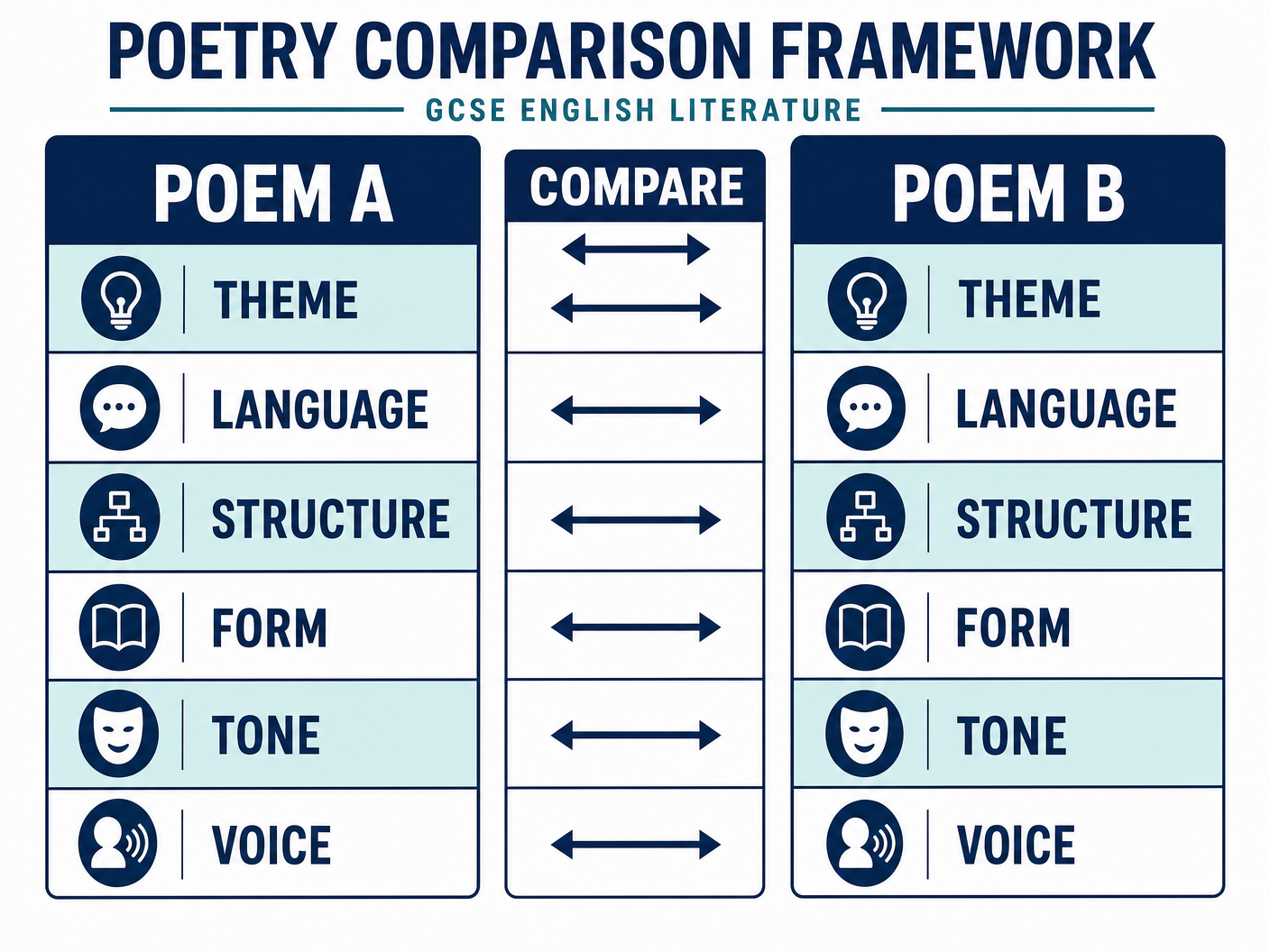
The central demand of this task is comparison. You are not writing two separate essays and stapling them together. Instead, you must explore how both poets approach the same theme, moving fluidly between the texts.
The 'So What?' Rule:
Identifying a technique (e.g., "The poet uses a metaphor") earns zero marks on its own. You must always explain the effect. What does the metaphor make the reader picture? How does it make them feel? How does it connect to the overarching theme?
Writer's Methods: The Toolkit
When examiners talk about 'methods', they mean the conscious choices the poet has made. You need to look at three key areas:
1. Language
This encompasses imagery (metaphors, similes, personification), word choice (connotations, semantic fields), and sound (alliteration, sibilance, assonance).
2. Structure
Structure refers to how the poem is built. Look at stanza lengths (are they uniform or chaotic?), line breaks (is there enjambment creating pace, or end-stopped lines creating finality?), and punctuation (does a caesura create a sudden, dramatic pause?).
3. Form
Form is the overarching category of the poem. Is it a sonnet, traditionally used for love poetry? Is it free verse, suggesting a rejection of rules or a stream of consciousness? Is it a dramatic monologue, where we must question the reliability of the speaker?
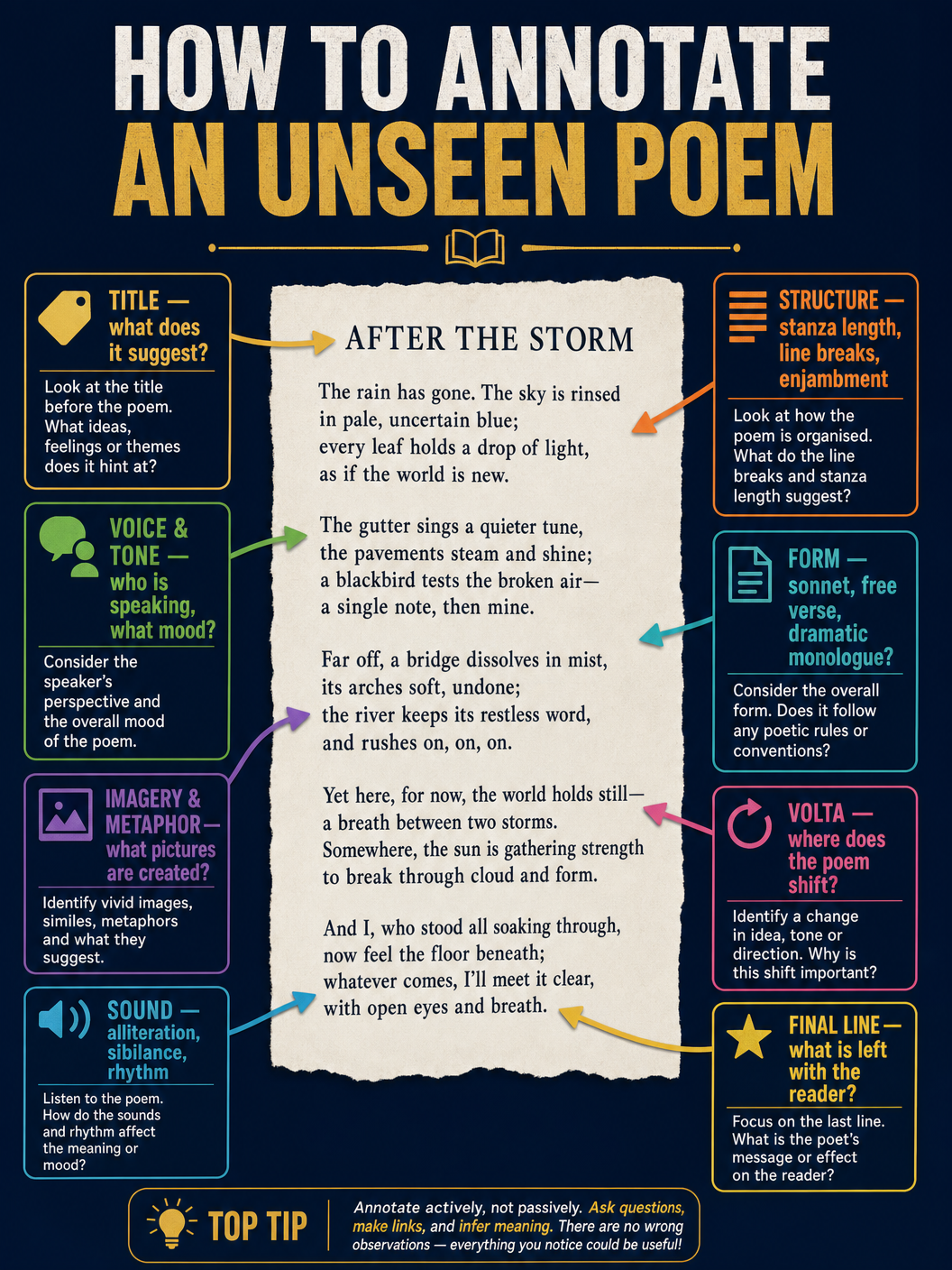
Approaching the Unseen Poem
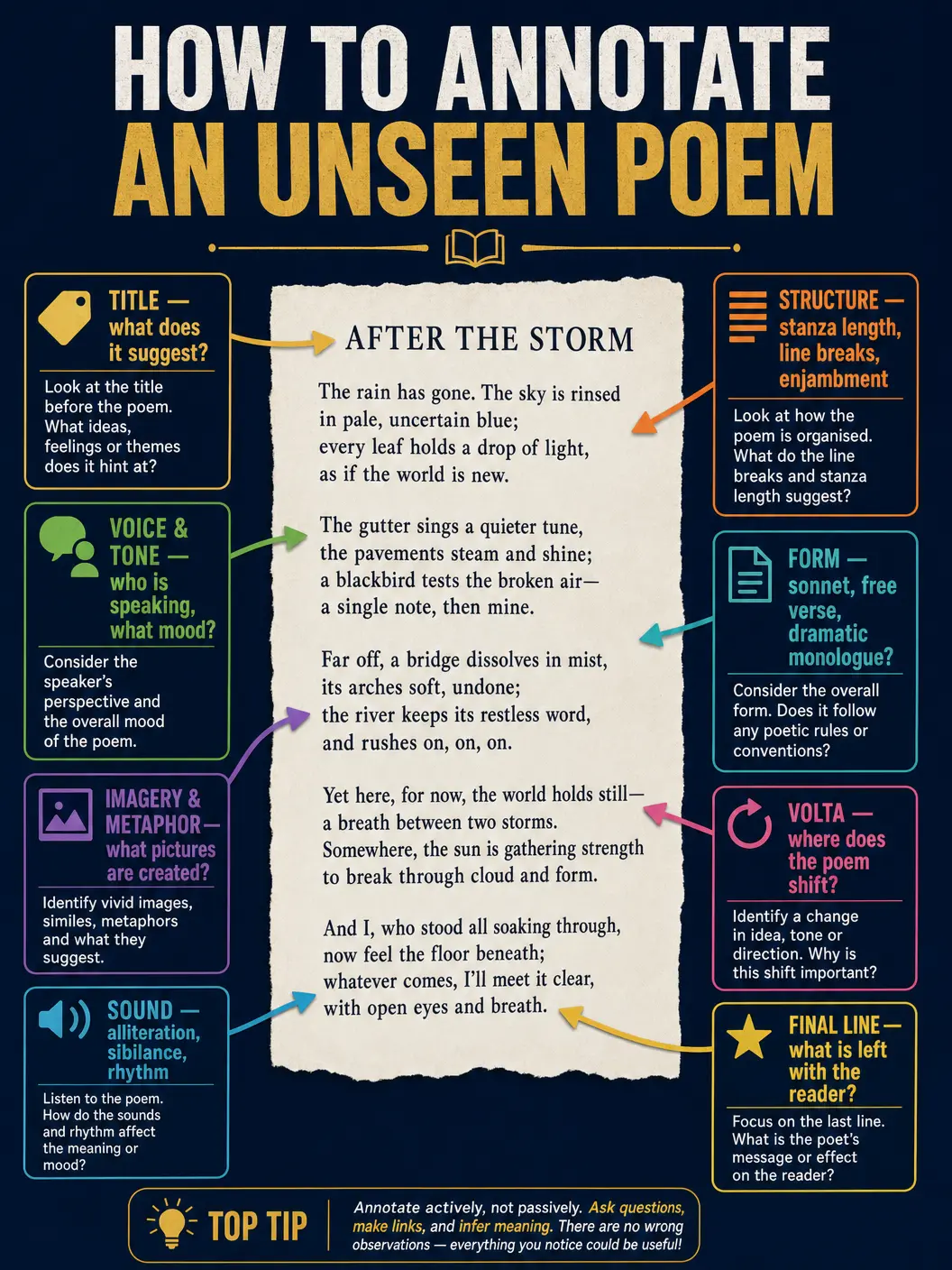
When you first encounter the poems, don't panic. Follow a systematic approach:
- The Title: Read it first. What expectations does it set?
- The First Read: Read for general meaning and mood. Who is speaking?
- The Second Read: Read with your pen. Look for the 'volta' (the turning point) and highlight key methods.
- The Final Line: What is the lasting impression left with the reader?
Context in Unseen Poetry
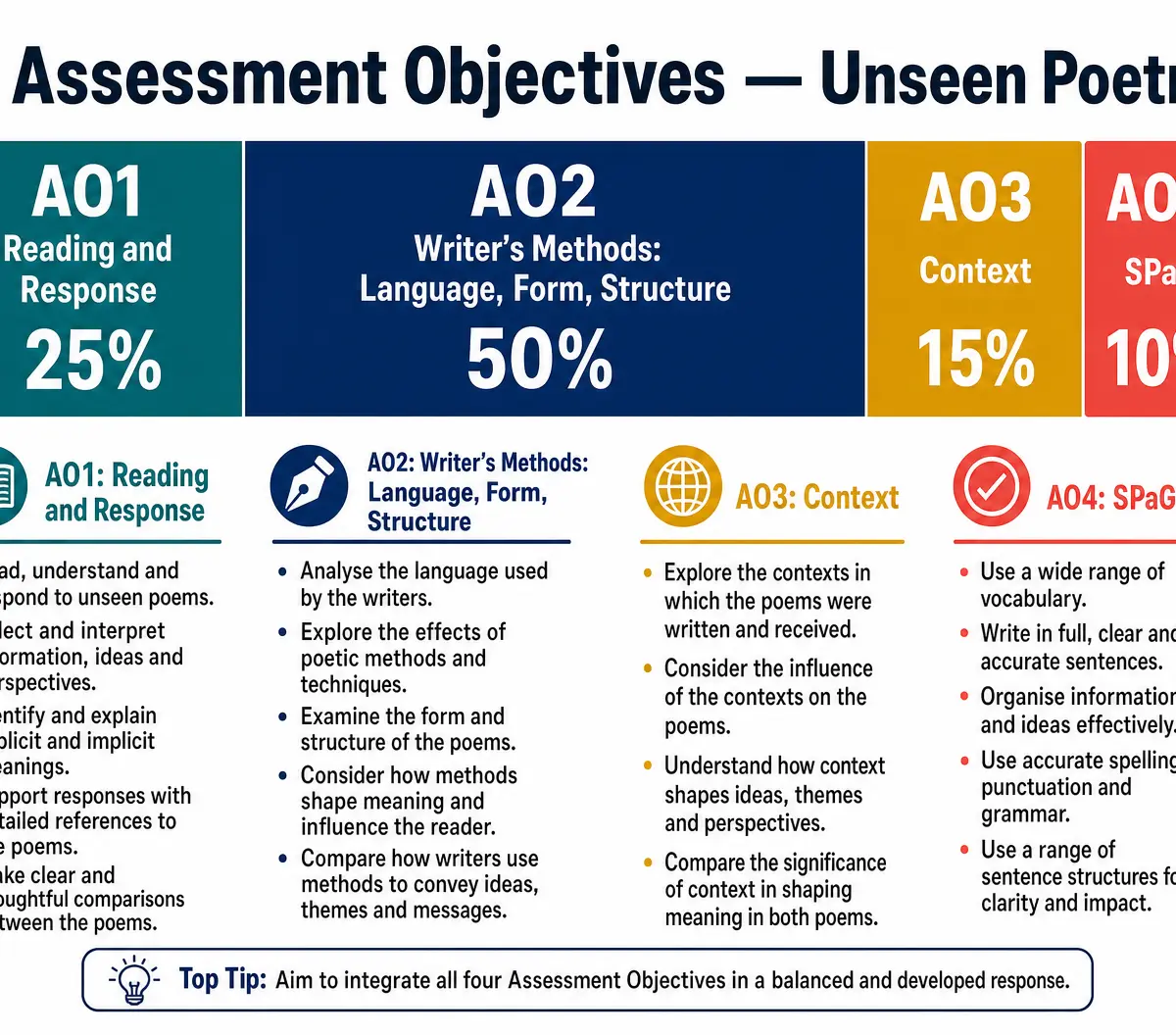
While you won't know the specific biographical details of the poets, you can still address AO3 (Context). Contemporary poetry frequently grapples with universal modern themes: identity, displacement, environmental concern, the legacy of conflict, and the complexities of human relationships. Ground your analysis in these broader social and cultural contexts.
Audio Masterclass
Listen to our comprehensive 10-minute podcast episode covering the core concepts, common pitfalls, and a quick-fire recall quiz to test your knowledge.

Visual Resources
3 diagrams and illustrations
Interactive Diagrams
1 interactive diagram to visualise key concepts
Conceptual Flow Outline
Workflow for approaching the Unseen Poetry Comparison task in the exam.
Worked Examples
2 worked examples — open one to explore the question and available guidance.
Practice Questions
Test your understanding — click to reveal model answers
In both 'City Night' and 'The Long Walk', the poets describe the experience of a journey. Compare how the poets present the experience of a journey. (30 marks + 4 AO4)
Hint: Consider the pace of the journey in both poems. How do line lengths and enjambment reflect the speed or difficulty of the walk?
In both 'The Heirloom' and 'Fading Photograph', the poets explore the theme of memory. Compare how the poets present the theme of memory. (30 marks + 4 AO4)
Hint: Look closely at the form. Is one a sonnet? Does the other use fragmented free verse? What does this say about how memory is preserved or lost?
In both 'First Day' and 'The Departure', the poets describe moments of significant change. Compare how the poets present these moments of change. (30 marks + 4 AO4)
Hint: Focus on the 'volta' or turning point in each poem. Where does the emotional shift happen?
In both 'Concrete' and 'The Old Tree', the poets explore the relationship between humanity and nature. Compare how the poets present this relationship. (30 marks + 4 AO4)
Hint: Look at the semantic fields. Which words are associated with humanity, and which with nature?